
What Is Self-Directed Support?
Self-Directed Support (SDS) is the framework through which social care is organised in Scotland. Established under the Social Care (Self-directed Support) (Scotland) Act 2013, it aims to put individuals at the centre of decisions about their care, giving them greater choice and control over the support they receive.
The process begins with an assessment of individual needs and desired outcomes. This should consider not only the hours of care required, but also what matters to the person and what would enable them to live as independently as possible. Once needs have been assessed, a budget is determined and four options for arranging support must be offered.
Understanding the four options
Option 1 provides a direct payment, allowing individuals to arrange their own support and employ personal assistants.
Option 2 allows individuals to choose their support while the council or another agreed arrangement manages the budget.
Option 3 involves the local authority arranging services directly, while
Option 4 combines elements of the other options.
There is no single right choice. The most suitable arrangement depends on personal circumstances and preferences, and support arrangements can be reviewed as needs change.
Free Personal Care and Chargeable Services
Free personal care is distinct from SDS. Under the Community Care and Health (Scotland) Act 2002, defined personal care tasks cannot be charged for by local authorities. These include assistance with personal hygiene, mealtimes, mobility, medication and general wellbeing. Free personal care has been available to adults of all ages in Scotland since April 2019 and is not means-tested.
Other services, such as housework, laundry, shopping and some social or recreational activities, may be chargeable following a financial assessment. Understanding this distinction is important when planning long-term care.
Case Studies: Putting Rights into Practice
Two case studies illustrate how SDS and free personal care can work in practice.
In the first, a 33-year-old man sustained a severe spinal injury in an accident and required two carers around the clock. He initially funded his care through a personal injury trust but became concerned that the money would not last his lifetime. Despite applying for free personal care, he was initially told that his trust fund prevented him from qualifying. The case highlighted the importance of distinguishing free personal care from other chargeable services and the difficulties people can face in securing support. Sixteen months after his assessment, funding remained unresolved, despite professional and political involvement.
The second case involved a man with similar, substantial care needs who successfully obtained an SDS package. His assessed support included personal hygiene, mealtimes, mobility, medication and general wellbeing. Other needs, including housework, laundry, shopping, appointments and recreational activities, were subject to financial assessment. Together, the cases demonstrate the importance of accurate assessments and clear decisions about which services qualify as free personal care.
Knowing Your Rights and Taking Action
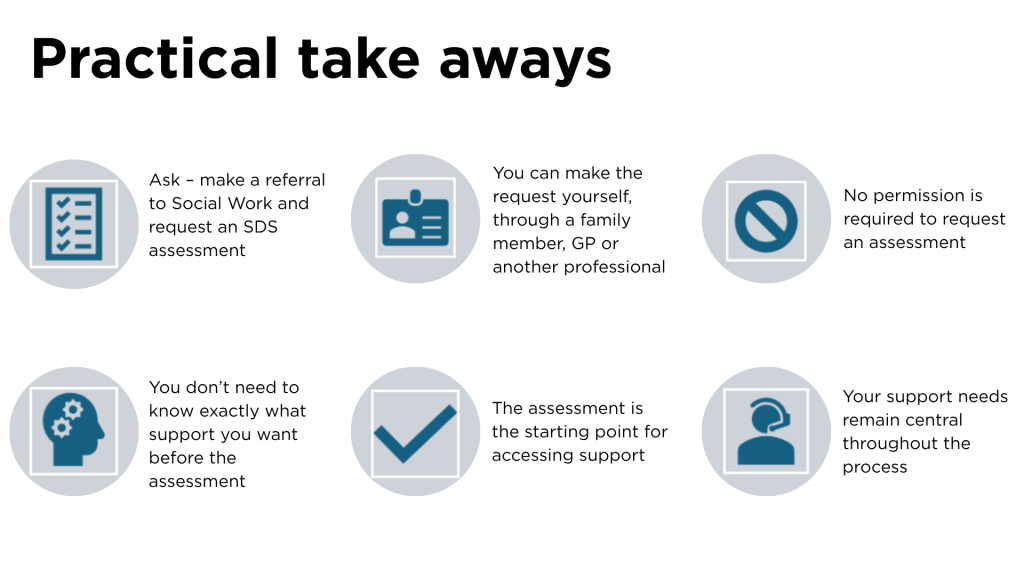
People have the right to be informed about all four SDS options, participate in assessments and reviews, and receive support to make decisions. Unpaid carers also have rights, including access to an adult carer support plan.
However, approaches can vary between local authorities, creating concerns about a postcode lottery in assessment and funding. If an assessment fails to reflect actual needs, concerns should be raised in writing. Refused applications or delays can be challenged through review and complaints procedures, with further escalation to the Scottish Public Services Ombudsman or a local MSP where appropriate.
Independent living organisations can also help people managing direct payments with recruitment, payroll, contracts and staffing arrangements.
Ultimately, support should reflect assessed needs and legal entitlements. Understanding these rights and seeking appropriate assistance can help individuals and families secure care that promotes dignity, independence and quality of life.
Written by Anne Cossar and Morven McLelland, Anne Cossar and Associates