• Skip to primary navigation
  • Skip to main content
  • Skip to primary sidebar
  • Skip to footer

Cerebral Palsy Scotland

  • Facebook
  • Instagram
  • LinkedIn
  • Home
  • Who we are
    • Our mission and values
    • What we do and why
    • Our story
    • Our team
    • Vacancies
    • Key documents
    • Our centre
  • How we help
    • Therapy for adults
    • Therapy for children
    • Support
    • Training
    • Campaigning
    • Our impact
  • What’s on
    • Events
    • Annual conference
  • Other support
    • Support directories
    • Financial support & equipment funding
    • Advice from parents
    • Online support groups
    • Support for schools
    • Legal support
  • Get information
    • All about cerebral palsy
    • Children
    • Adults
    • Therapy & treatment
    • Oral health
  • News
    • News
    • Blog
  • Get involved
    • Friends of Cerebral Palsy Scotland
    • Raise money
    • Leaving a gift in your Will
    • Corporate partners
    • Philanthropy and major donors
    • Other ways to give
    • Other ways to get involved
    • Trusts
    • Our promise to you

How Covid restrictions have affected access to public spaces

Bernie

Cerebral Palsy Scotland volunteer Bernie Hunter writes about the impact that Covid-19 restrictions have had on disabled access to public spaces including pavements, shops, bars and supermarkets.

As the Covid-19 restrictions start to ease and things are becoming a bit more normal again I have been finding out about how the access world has changed slightly for people who use mobility aids, since the start of the Covid-19 rules. In this recent study, I will explain what the differences are when it comes to accessing places compared to pre-lockdown.

Over the past 16 months, life has looked a lot different for us all. We have had to get used to changes due to the pandemic. The restrictions were brought in to try and slow the spread of Covid-19 which was the right thing to do as everyone’s health has to come first. As the virus started to get under control, the hospitality industry was allowed to open but only to operate outdoors. This resulted in a lot of businesses having to set up tables and chairs outside their pubs and restaurants for customers. It was the only way that they could open. While this was all a better environment for people to be in, it wasn’t always the best set up for everyone.

People who use mobility aids have noticed a big access change when they are out and I’m not talking about places having disabled access – I’m actually talking about when someone in a wheelchair or a walker tries to go along a pavement. Most pubs have set up beer gardens right outside their venues which sometimes can mean that the table and chairs are directly on the pavement, not leaving enough space for mobility aid users to get by. Unfortunately, these changes have not been a plus for people with access needs. Although customers are apologetic (it isn’t anyone’s fault that there is obstructions) but this leaves the wheelchair or walker user feeling embarrassed that they have had to ask someone to move to let them past.

There has been changes in shops due to the social distancing requirement, some stores have made the aisles wider- this has benefited people who use wheelchairs as there is more room to get around the shop. This is a welcome change, but it isn’t like that in every store, some places have cut down floor space to allow social distancing to happen by putting up screens and barriers.

Parking has also been a problem for blue badge holders- the accessible parking bays are located near to the shops entrance but due to stores having to introduce a ‘queuing system’ and making sure social distancing was in place, a lot of shops blocked off their disabled bays to let more people queue. This left people with access needs with no choice but to park a bit away from shops.

Let’s talk a bit about how access has changed in eating places. One restaurant has unfortunately blocked off their accessible ramp and side entrance so that they can have a beer garden. This means people who use mobility aids don’t have suitable access into the restaurant. The venue has bought a portable ramp since, but it is very steep and dangerous… resulting in making customers nervous and requiring assistance to use it.

Considering the restrictions, everyone is more understanding that changes were needed to make places a safer place when Covid-19 appeared but we should remember that all of the world still must be inclusive. Everyone has a right to access, nobody should be faced with challenges when out and about.

In a recent Cerebral Palsy Scotland Twitter poll, we asked if people noticed a change in accessing places since the Covid-19 restrictions started- 60% said yes and 40% said no.

Thank you also to everyone who responded to our Facebook request and shared their own experiences of changes to access during Covid-19 restrictions – you made all the difference to this blog.

My move into supportive accommodation

Cerebral Palsy Scotland volunteer Marion

This blog from Marion is about her experience with moving into supportive accommodation and some of the changes and challenges she has had to face in the process.

Hello everyone again. This blog which you are about to read will be about my experience with moving into supportive accommodation. I will also talk a bit about my previous houses, as well as the huge change I needed to make to my life.

I first moved into my own flat in 2008, and at the time I was supported for most of the week including overnights. I became an advocacy worker and  worked regularly in an office, which I loved. I had a great team of support workers and some are still great friends. Over time I moved to another house at the other side of Paisley. I got support but unfortunately I did not get full support while I was there but it was still nice to have a bit of independence. I also became a volunteer at Cerebral Palsy Scotland.

All my life, my parents and I always promoted my independence since attending the Bobath Centre in London from the age of one. “She does the work, not you”, I can still hear my dad saying!

In 2020, before the pandemic, my Social Work Department offered me the chance of moving into supportive accommodation. I wasn’t that keen on the idea but I knew for the future that was the best option for me. I got the keys to my new flat finally in the August.

During the lock-down period I had many zoom meetings to set up my service with my service provider. I finally got my team of support workers this March after months of interviews.

In May I moved in. For the first time in my life I was on my own at night. I can get support if I need it from an on-site core team. It is still hard to get used to.

It has not been that easy for me to deal with all the changes I needed to make to my life, like using a hoist instead of a stand aid because of my service provider’s rules.

Another change is, I can’t sit on my sofa every night. That means I’m in my wheelchair for nearly 15 hours a day.

Being brought up one way, e.g. therapy, doing what I want without thinking about how I can get to the toilet when I am out, and also being able to stand many times a day, I now need to adjust to another way.  I need to use a hoist, so I feel my world has become more limited. That is what I’m struggling with big time.

I feel like I need to make the best I can out of the situation that I find myself in. My advice to people who find themselves in a similar situation is, you have to be patient and keep going.

Even if you are worried you have to give it a good try and you may be amazed by what you can do.

Tags: accommodation, blog, Cerebral Palsy, supportive accommodation

Using my toe to type

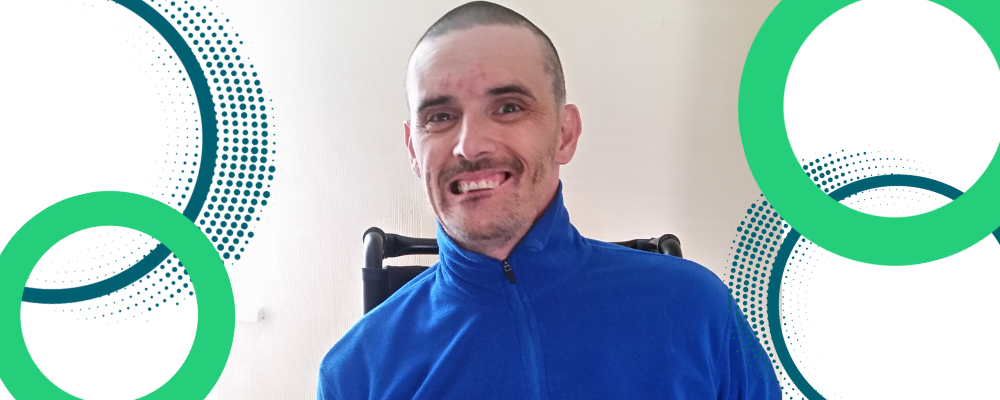
Image of Barry smiling at the camera

In this blog, Barry talks about the skills he has developed to allow him to type and use a computer.

Hi, it is Barry Smith or Baz as I like to be called by my friends. As you all know I have cerebral palsy, but it doesn’t stop me from writing on my computer.

Image of Barry using his foot to typeBut I don’t use my hands. I have a big keyboard with an overlay on top of it. Down to my hands is very jumping which comes off of my CP, I type with my big toe. Then down to me can’t work a mouse, I use a jelly skill and work it with my foot.

I started using my big toe do things when I was 6 years old, like working the video. When I was 19 years old I got roll ball I move it with my toe.

In 2013 when I was doing a computing course at my local college, a boy looked in my classroom. One of the staff asked him what he were doing, thinking he was up to no good. He told her, I can’t get over him using his toe!

I use my skills to communicate to people what I want in my life. How I feel about having CP – if my hands can’t do something and my big toe or foot can, then I use them. My legs might can’t walk, but this won’t stop me.

Tags: blog, Cerebral Palsy, Communication

Anyone can dance

Bernie dancing with a group in the Macrobert Arts Centre

This week, blogger Bernie Hunter shares her experiences of learning to dance, the adventures it has taken her on, and what happened next.

Dance was a big part of my teenage years – not many people know this so let me take you into my dance world. In this blog, I will give you an insight into my performance days including sharing my experiences of rehearsals and shows.

Bernie dancing in the theatre royal

In 2009, I came across a music and dance workshop that was taking place at a local theatre. It was during the summer holidays so I was up for trying something new even although I hadn’t danced before. The group was called ‘Make Music Move’ (now M3) involving professional dancers and musicians from the organisation Paragon Music. Paragon, is a music charity that helps people with additional support needs to create music and dance. They teamed up with a wonderful choreographer, Caroline Bowditch as well as another dance company to create M3.

Everyone was welcomed into the workshop, it was very inclusive- the group didn’t see disability and as a teenager, that really helped me.

I watched how the dancers worked with the participants and that was when I realised that this was something special. After a couple of sessions, I started to take a real interest in dance. I attended M3 as a participant dancer for 5 years- I had many opportunities handed to me on a plate that I will always be thankful for.

M3 ran regularly with rehearsals happening throughout the year plus intensive weeks every so often, this was when we were creating a piece. We had a number of performances to do as part of dance shows in theatres. This is where the opportunities came in – I got to perform in the Theatre Royal, Glasgow…what a feeling and I also travelled to Dundee Rep Theatre annually too. That doesn’t happen to people like me and I don’t mean because of my disability, just in general.

My theatre memories will always be a big part of my dance days, the experience is just phenomenal. A real mix of feelings when you are out on that stage of excitement but lots of nerves too. One memory that comes to mind is when I was doing a solo dance and an hour before the show in Dundee, I found out that not only that I was the first member of M3 on stage but I was opening the WHOLE dance show…total fear waiting side of stage but such a joy to do.

Talking of my solo dance piece, I actually created it myself in my living room. I went into rehearsals the next day and told my dancers that I made a dance…they couldn’t believe it and I was so thankful that it made the stage. I was told by Caroline that I could go down the dance route as a future and that meant so much to me.

I never thought that I would be a dancer due to having Cerebral Palsy with my movements and being in a wheelchair but anything is possible.

The professional dancers were very good with me, we worked together and came up with moves that I could do in my chair. A couple of years into my dance journey, I decided that I wanted to come out of my wheelchair to dance duets…it was the best decision ever. I could do so much more…it was freedom. My fellow M3 participants followed me and at one point, everyone was dancing out of their chairs!

As I got older and life got busier, I had to leave M3. Unfortunately, I couldn’t attend all the rehearsals. Although that this was the case, I helped Paragon Music run M3’s social media accounts which then leaded to me being a volunteer with Paragon- I am the charity’s Digital Development Assistant now.

Bernie & Caroline Bowditch dancingI would like to give a big shout-out and thanks to Paragon’s creative director, Ninian Perry and former dance artist in Association with Paragon, Caroline Bowditch for supporting me through my dance journey- I really learnt a lot from two of the nicest people ever. All of the dancers and musicians were like a big family and I am so lucky that I still keep in touch with friends from M3- I will always be grateful for my dance days.

Mini Q&A

Favourite Memory – Performing in the Kings Theatre Royal to ‘Let music make you move, set your feelings free’

Most Pressured Show – Leading a dance piece at Macrobert Art Centre, Stirling. 8 beats!! If I counted it wrong then it would have affected our whole piece

Do I miss dancing? – Yeah, I do and I would go back if there was an opportunity

Favourite Venue – Kings Theatre Royal

Barry: Respite care and holidays

Image of Barry smiling at the camera

Respite care and holidays

Hello, it is Baz Smith here again with a blog and I am going tell you about two holiday centres which are run for disabled people. The centres I am talking about have 24 hours care for people who need it.

The first one I am going to talk about have four centres in England. The nearest one to Scotland is in Southport and it is call Sandpipers. I went there about six weeks before the first lockdown started, thank god I was back up the road before the UK told everyone Stay at home in March last year. The centre has Nurses and Careers all around the clock to meet the needs of disabled people. It has a bar for anyone who likes a drink. The centre looks onto the sea, which looks nice when the sun goes down at night. As well it has an indoor swimming pool. I knew before COVID19 you just need ask a member of staff and they would get it planned for you to go in with Volunteers to watch you when swimming.

You would get three meals a day. Breakfast is cooked for people who want it, or you can have a cold Breakfast. If you need help to eat or your food cut up someone will help you. When eating your breakfast have a look at the Dinner (Tea) menu and if nothing you like was on it, please tell a member of staff and they will let the cook know and they will come and ask what you want to eat.

Before COVID-19 they did bus run to get people out, but I do not know about now. Most days the Bus runs to visit some places liked the shops in different towns. If you want go you can go to four places a week. A member of staff would come around on a Monday and tell them what trips are on for that week, and the person picks. Then when everyone has picked the staff tell everybody when they are going out and who will be going with them to meet their support need. On the day you are out you are given a packed lurch before you go on the bus. All their buses have lift for wheelchair, or if you are not good on your feet.

You might be asking yourself now can I get there from Scotland, if you get the train down you need to change at Waling then walk about 5 minutes’ walk. If you are in wheelchair you must book Trains and Ramps. When you get to Southport you get cab up to Sandpipers or walk up, which would take about 30 minute. You will pass by the smallest pub in England but it doesn’t have any Wheelchair access.

In every bedroom there is your own Tv and en-suite toilet with hand rail and a wheelchair access Shower and Shower Chair if needed, as well over head Hoist and the beds can move up and down. There is an on call button. The night staff can do night check if for anyone who needs it.

If you do not want to go Sandpipers, they have three more Centres around England, to find more about them please visit https://revitalise.org.uk/

The next Holiday place I am going tell you about is Calvert Kielder.

You can go there with your family or friends. Or, if you are over age of 18 you can go on respite and let their Staff take care of you.

At Calvert Kielder they have got a respite team for any disabled person over the age of 18 who wants go on holiday by themselves and get their support needs met by the team at Kielder, like washing, bathing, dressing and feeding. When booking you tell them your needs so the staff know how to support you on your holiday.

If you are a part of the respite team, the staff will make a support plan up with you, so all your needs will get met. You will stay in main centre where the carers are on around the clock. If you are on respite team you get three meals a days and a programme of things do is setup. for liked going a Buggy and water sports no matter which age you are.

Family who have someone with a disability can go and stay in a little house and ask if they can take part in things to do. It has a swimming pool and a hot room to. Some schools go because it is an outdoor holiday. If you need help to get there they would pick you up anywhere within 50 miles for a small cost, they have wheelchairs and all the aids you could think of.

Tags: Days out, Sport and Leisure

  • « Go to Previous Page
  • Page 1
  • Interim pages omitted …
  • Page 10
  • Page 11
  • Page 12
  • Page 13
  • Page 14
  • Interim pages omitted …
  • Page 26
  • Go to Next Page »

Search

Quick links

  • Ways to give
  • Our mission and values
  • All about cerebral palsy
  • Therapy for adults
  • Therapy for children
  • Campaigning

Copyright © 2025 · Enterprise Pro on Genesis Framework · WordPress · Log in

Cerebral Palsy Scotland logo

Cerebral Palsy Scotland
Bradbury House
10 High Craighall Road
Glasgow, G4 9UD

t: 0141 352 5000
Phone Number for Cerebral Palsy Scotland
Fax Number for Cerebral Palsy Scotland
info@cpscot.org.uk
Email for Cerebral Palsy Scotland
cerebralpalsyscotland.org.uk
Website for Cerebral Palsy Scotland

  • Facebook
  • Instagram
  • LinkedIn
OSCR logo
Nationa Lottery Community Fund logo